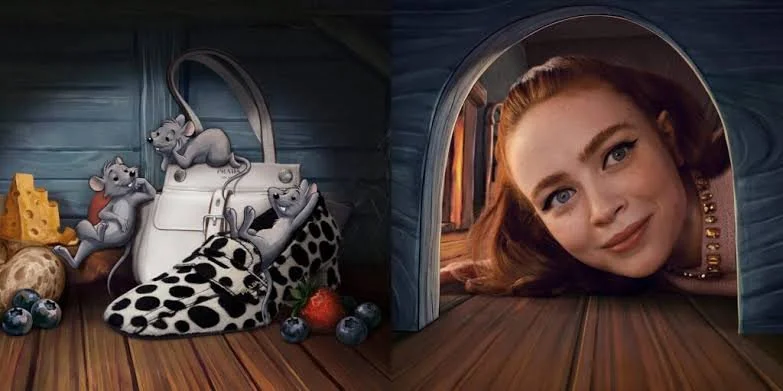
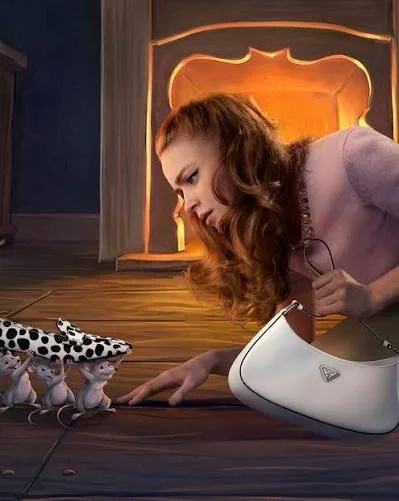
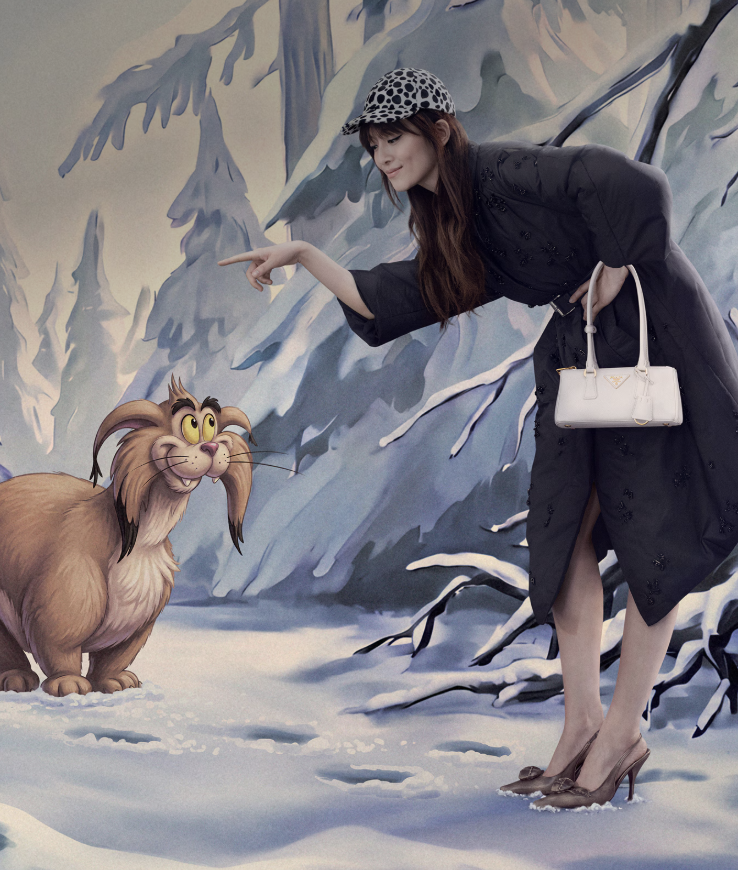
As brands race to integrate artificial intelligence into their creative processes, Prada has taken a decidedly different approach for its 2026 holiday campaign. Titled Drawing Prada: Animated by Hand, the campaign combines live-action photography with traditional pencil-and-paper animation, placing actors including Sadie Sink, Maya Hawke and Kelvin Harrison Jr. inside illustrated winter landscapes.
The project was developed under the creative direction of Miuccia Prada and Raf Simons, with veteran animator John Pomeroy leading a team of artists and photographer Glen Luchford capturing the live-action scenes. Rather than generating a fantasy world digitally, Prada built one through a process requiring artists to draw the characters and environments by hand.
The result is more than a seasonal campaign. At a moment when technology is changing how advertising is produced, Prada is putting the creative process itself at the centre of its storytelling.
Courtesy of Prada
When Efficiency Isn't the Point
Generative AI is rapidly becoming part of the advertising industry's infrastructure. According to the Interactive Advertising Bureau's January 2026 research, 83% of surveyed advertising executives said their companies had deployed AI in the creative process, up from 60% in 2024. Cost efficiency has also become a leading motivation for adoption.
Yet consumer attitudes are more complicated. The same study found that 45% of surveyed US Gen Z and Millennial consumers felt positively about AI-generated advertising, compared with 82% of advertising executives who believed younger consumers viewed it positively. Among Gen Z respondents, 30% associated brands using AI in advertising with being inauthentic.
Academic research points to a similar tension in luxury. A 2025 study published in the Journal of Advertising Research, titled When AI Doesn't Sell Prada: Why Using AI-Generated Advertisements Backfires for Luxury Brands, found that disclosing the use of AI-generated imagery could lead to more negative consumer evaluations. The researchers linked this response to perceptions that AI-generated advertisements require less effort and feel less authentic to a luxury brand.
These findings do not mean consumers universally reject AI, nor do they establish why Prada chose traditional animation. They do, however, reveal a challenge for brands whose value depends partly on craftsmanship, creative distinction and the perception that something meaningful has gone into making a product or experience.
Courtesy of Prada
Selling the Process, Not Just the Product
Prada's campaign makes the labour behind the finished image visible. Pomeroy, whose career includes animated films such as The Land Before Time and Disney's Pocahontas, brought decades of experience in traditional animation to the project. The illustrated animals, snowy landscapes and fantastical scenes are not simply visual effects. They are the outcome of a particular creative discipline.
In behind-the-scenes footage released by the brand, Pomeroy describes the intention as demonstrating the continuing value of the human touch. It is a message that connects the campaign's production method to a broader luxury proposition: the value of an object or experience can lie not only in its final appearance, but also in the skill, time and decisions involved in creating it.
This is especially relevant as AI makes polished imagery easier to produce at scale. When visual perfection becomes more accessible, brands need other ways to distinguish their work. A recognisable creative process, a specific artistic perspective or a collaboration with an established practitioner can offer a more meaningful point of difference than another technically impressive image.
A Different Kind of Luxury Signal
Prada is not rejecting technology across its business, and one campaign does not establish a wider industry shift. Its significance lies in the choice to make traditional craftsmanship the central idea of a major seasonal campaign when automated creative production is becoming increasingly common.
For luxury brands, the commercial question is not whether AI can produce compelling imagery. It is whether using it strengthens or weakens the qualities consumers associate with the brand. In some contexts, AI may improve creative possibilities. In others, visibly human work may carry greater emotional and cultural value.
Prada's holiday campaign suggests that, in an increasingly automated creative landscape, the human process itself can become part of what a brand is selling. The technology may continue to advance, but the ability to demonstrate intention, skill and authorship could become an increasingly valuable form of differentiation.