Milan and Copenhagen have long dominated the international design conversation. But a new generation of designers is building a case for Lagos as another city to watch, with work that combines cultural references, sculptural forms and a growing ambition to move beyond exhibitions into commercial production.
The latest edition of Design Week Lagos, which ran from 18 to 25 October at the National Theatre, explored this ambition under the theme Making a New Africa: From Material to Market. Among the projects highlighted by Wallpaper were furniture and lighting pieces that challenged conventional ideas of what contemporary African design should look like.
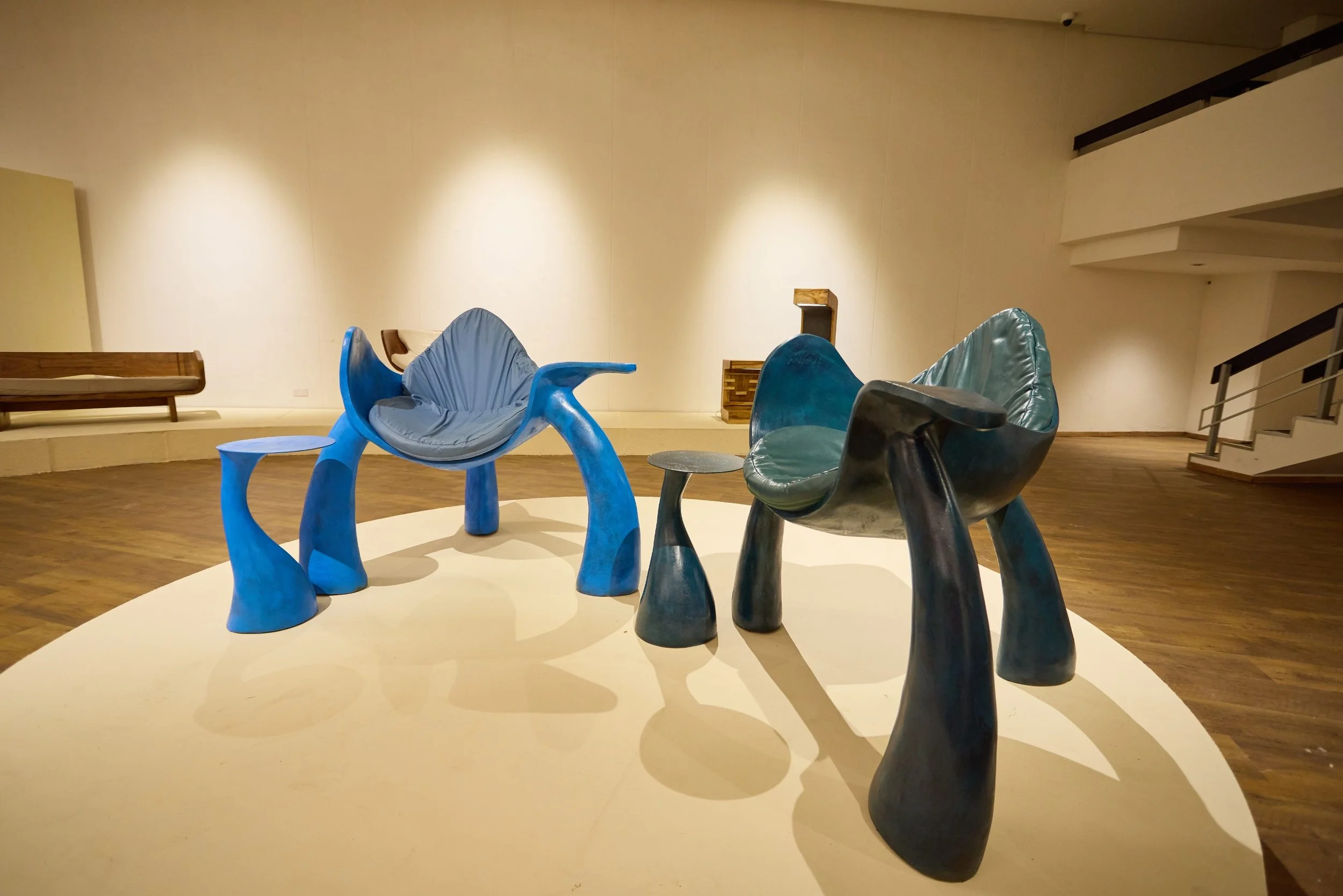
Chair: Ijapa by Ajayi Kehinde Gabriel, Àjàyí Studio. Photography: Tobi Oluwarotimi for Design Week Lagos.
Beyond Craft and Cultural Identity
The selection demonstrated how differently designers are interpreting their cultural references. Nigerian designer Ajayi Kehinde Gabriel's Ijapa chair, created for Àjàyí Studio, takes inspiration from a tortoise, translating its form into a sculptural blue seat with curved legs. James Brendan Udom's Okkyo lamp adopts an anthropomorphic silhouette, combining functional lighting with an almost character-like presence.
Nicole Adaora Enwonwu's Ànyánwụ́ lamp draws on Igbo cosmology, exploring light as a living force through a looping terracotta structure. Meanwhile, Cameroonian artist Djakou Kassi Nathalie presented handcrafted mahogany chairs featuring interlocking abstract faces and geometric motifs.
The pieces share an interest in form, material and cultural reference, but they resist being reduced to a single aesthetic. That distinction matters in a global design market where African creativity is often presented primarily through the lens of heritage and traditional craft. These designers are using cultural references as starting points for contemporary product design, rather than treating them as a fixed visual language.
From Exhibition to Industry
The more consequential development may be happening beyond the objects themselves. Design Week Lagos's 2026 theme placed manufacturing and commercial viability at the centre of its programme, raising a question that emerging designers everywhere face: how does an idea move from an exhibition stand into production, distribution and people's homes?
Its All Roads Lead to Lagos programme has been taking Nigerian design talent to international audiences, including Milan and Paris. The initiative also introduced a designer-manufacturer collaboration with Italian lighting company Ombré, creating a route towards production that extends beyond simply presenting work to international audiences.
This is an important distinction. Visibility can introduce designers to new markets, but sustainable creative industries also need manufacturers, investment, distribution networks and customers willing to buy the finished products.
Lagos is not competing with Milan by trying to replicate its design ecosystem. Its opportunity lies in developing its own, connecting local creative talent with the infrastructure required to bring ideas to market.
The international design calendar has room for more than its established capitals. Whether Lagos can turn growing recognition into a lasting position will depend not only on the quality of the work, but on the industry built around it.