Nike is preparing to make its case to investors at a particularly difficult moment. As the company begins its first Investor Day in almost a decade on November 16 and 17, it is facing declining sales, intensifying competition and questions about whether it can regain the cultural influence that once made it the undisputed leader of sportswear. Even its latest product releases offer an interesting point of entry into that conversation.
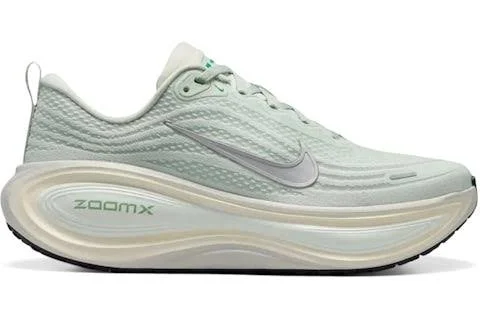
The new Nike Vomero Plus "Sea Glass" running shoe arrives without the Swoosh. Its upper features a wavy pattern in grey, black and cream, while the oversized ZoomX sole comes in bubblegum pink. Priced at $175, the shoe is part of a small group of logo-free Vomero releases. It is an unusual choice for a company whose logo is among the most recognizable symbols in global consumer culture. But perhaps the more interesting question is not why Nike would remove its most valuable visual asset. It is whether the product can generate enough interest to sell without relying on it.
That question comes at a time when Nike needs to prove that its product innovation can once again create demand. In fiscal 2024, the company generated $51.4 billion in revenue. By fiscal 2025, that figure had fallen to $46.3 billion, before remaining largely unchanged at $46.4 billion in fiscal 2026. On a currency-neutral basis, revenue declined 2% in the latest financial year. The first quarter of fiscal 2027 offered little reassurance: revenue fell another 4% year over year to $11.2 billion.
The pressure is visible across several parts of the business. Nike Direct revenue declined 9% on a currency-neutral basis in the latest quarter, with digital sales falling 13%. Greater China revenue dropped 26%, while Converse, another important part of the group's portfolio, declined 28%. North America provided some relief, but the overall figures suggest that Nike's recovery remains uneven.
How Nike lost some of its advantage
Nike's difficulties cannot be explained by one competitor or a sudden change in consumer preferences. Over recent years, the company leaned heavily into established franchises, including the Dunk and Air Jordan ranges, while shifting its distribution strategy toward direct-to-consumer sales. That approach gave Nike greater control over its customer relationships and retail margins, but it also reduced its presence with wholesale partners, creating opportunities for competitors to occupy valuable retail space.
At the same time, repeated releases of familiar silhouettes and increased discounting weakened the sense of exclusivity that had helped make certain Nike products desirable. Reuters reported that Nike's share of the global sports footwear market fell three percentage points in 2025, to 22.9%, as Adidas gained ground and challenger brands continued to expand. Companies such as On and Hoka have built strong positions in performance running, while Chinese competitors Anta and Li-Ning have become increasingly relevant in their home market.
The challenge is not simply that consumers have more choices. It is that competitors are giving them compelling reasons to choose something different. In performance footwear, technical credibility and product differentiation matter as much as heritage. In fashion and lifestyle, cultural relevance can change quickly. Nike still has an extraordinary archive, athlete roster and global recognition, but those assets cannot guarantee that its next release will become the product people want.
The turnaround is about returning to sport
CEO Elliott Hill, who returned to Nike in 2024 after spending more than three decades at the company, has been trying to redirect the business toward its strongest foundation: sport. Its strategy, known internally as Sport Offense, places greater emphasis on performance innovation, athlete relationships and building products around specific sports rather than relying too heavily on lifestyle franchises.
There are encouraging signs. Nike reported five consecutive quarters of double-digit growth in its running business through fiscal 2026, adding approximately $1 billion in revenue over that period. The company also reported gaining five percentage points of running market share in statement footwear across North America and Western Europe. These are meaningful results, although they have not yet been enough to offset weakness elsewhere.
Nike has also begun rebuilding its wholesale relationships and improving its presence in physical retail. In fiscal 2026, wholesale revenue increased 4% on a currency-neutral basis, while Nike refreshed more than 15,000 retail spaces within wholesale partners' stores. Its new operating model, called Pace, is intended to make the business more responsive through supply chain modernization, regional restructuring and changes to its workforce.
What investors need to hear
The November Investor Day is an opportunity for Hill and his leadership team to explain how these changes translate into sustainable growth. Investors will be looking for more than another list of cost reductions or organizational adjustments. They need a credible product roadmap, a clearer plan for Greater China, a strategy to restore the appeal of Jordan and Sportswear, and evidence that Nike can improve its direct business without weakening its wider retail network.
But there is a larger issue that financial targets alone cannot resolve. Nike needs to recover its ability to influence consumer taste. For decades, it did more than sell athletic footwear. It shaped the conversation around sport, music, fashion and identity. Its most successful products became cultural reference points, not simply items in a seasonal collection.
The Swoosh-free Vomero Plus is unlikely to change Nike's financial trajectory on its own. But it illustrates an interesting tension: the company has spent decades building the world's most recognizable sportswear symbol, and now it must prove that its products can create desire beyond the power of that symbol.
Nike does not need to become a different brand. It needs to make people excited about what comes next. Its comeback will ultimately depend less on how effectively it explains its strategy to investors and more on whether consumers once again see Nike as the brand setting the pace, rather than trying to catch up.